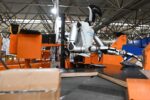
China has become one of the world’s leading adopters of AI-powered robots in postal and logistics operations. Rather than replacing every postal worker, the country’s postal operators—especially China Post—are using a combination of artificial intelligence, humanoid robots, robotic arms, autonomous mobile robots (AGVs), unmanned delivery vehicles, and AI software to automate repetitive and physically demanding tasks.


Here’s a detailed overview of how AI robots are being used.
1. AI-Powered Parcel Sorting
The largest use of AI robots is in parcel sorting centers.
How it works
When a parcel arrives:
- AI cameras scan the barcode or shipping label.
- Computer vision identifies the parcel’s size, shape, and orientation.
- AI determines the correct destination.
- A robot picks up the parcel.
- The parcel is placed onto the appropriate conveyor or sorting bin.
Modern systems can recognize damaged labels, oddly shaped parcels, and packages placed upside down.
Recent deployments at China Post’s Guangzhou postal center introduced humanoid robots capable of sorting and identifying parcels, each processing up to 1,200 parcels per hour while working alongside robotic arms and automated conveyors. (People’s Daily Online)
2. Humanoid Robots
One of the newest developments is the use of humanoid robots that resemble humans.
Unlike traditional robotic arms that perform one fixed task, humanoid robots can:
- walk around warehouses
- pick up parcels
- rotate packages so labels face upward
- recognize different parcel types
- place items onto conveyors
- work alongside human employees
These robots use:
- AI vision
- depth cameras
- force sensors
- machine learning
- autonomous navigation
Because they have two arms and human-like movement, they can work in spaces originally designed for people.
3. AI Computer Vision
AI vision systems continuously inspect parcels.
They can detect:
- damaged packages
- missing labels
- incorrect barcodes
- package orientation
- oversized parcels
- hazardous items
Instead of stopping the production line, AI automatically flags unusual parcels for human inspection.
4. Robotic Arms
Industrial robotic arms are widely deployed for repetitive tasks.
Their jobs include:
- loading parcels
- unloading trucks
- placing parcels on conveyors
- stacking boxes
- feeding parcels into sorting machines
These robots work continuously with high accuracy and significantly reduce manual lifting. China Post has highlighted AI vision-guided robotic arms as part of its move toward more automated processing centers. (China Post)
5. AGVs (Autonomous Guided Vehicles)
Many China Post facilities use AGVs instead of workers pushing carts.
These robots:
- transport mail containers
- move parcels between workstations
- avoid obstacles
- recharge automatically
- calculate the shortest routes
Benefits include:
- fewer workplace injuries
- faster transportation
- continuous operation
- lower labor costs
Some centers report thousands of parcels processed per hour using fleets of these robots. (China Post)
6. Autonomous Delivery Vehicles
China Post has also tested autonomous delivery vehicles.
These self-driving vehicles can:
- deliver parcels inside office parks
- travel across university campuses
- navigate business districts
- stop at designated delivery points
Many operate at Level 4 autonomous driving, meaning they can drive themselves in approved environments while being remotely monitored if necessary. China Post began piloting integrated outdoor autonomous vehicles with indoor delivery robots in 2023. (China Post)
7. Indoor Delivery Robots
Inside office buildings and campuses, delivery robots can:
- enter buildings
- call elevators
- ride elevators automatically
- navigate hallways
- notify recipients
- deliver parcels directly to offices
The robots communicate with building systems, allowing doors and elevators to operate automatically. (China Post)
8. AI Scheduling Systems
AI also manages logistics operations behind the scenes by deciding:
- which sorting line to use
- where robots should work
- how to balance workloads
- when to recharge robots
- how to optimize delivery routes
These systems reduce congestion and improve overall efficiency.
9. Predictive Maintenance
AI monitors equipment such as:
- conveyor belts
- robotic arms
- motors
- sensors
It predicts failures before they occur, reducing downtime and maintenance costs.
10. Digital Twins
Some modern postal centers create virtual models of their operations.
AI simulations help managers:
- predict bottlenecks
- test new layouts
- optimize robot movements
- improve processing capacity
Technologies Behind the Robots
China Post combines several AI technologies:
| Technology | Purpose |
|---|---|
| Computer Vision | Reads labels and identifies parcels |
| Machine Learning | Improves sorting accuracy over time |
| Robotics | Picks up and moves parcels |
| SLAM Navigation | Helps mobile robots navigate warehouses |
| LiDAR | Detects obstacles and maps surroundings |
| IoT Sensors | Tracks equipment and parcel movement |
| AI Scheduling | Assigns work to robots efficiently |
| Cloud Computing | Coordinates data across multiple facilities |
Benefits
China Post reports several advantages from automation:
- Faster parcel processing
- 24/7 operation
- Higher sorting accuracy
- Reduced physical strain on workers
- Better handling of peak shopping seasons
- Improved delivery efficiency
China Post has also outlined a broader strategy that includes expanding unmanned vehicles, drones, AI vision systems, and increasingly automated processing centers across its network. (China Post)
Challenges
Despite rapid progress, there are still limitations:
- High upfront costs
- Complex maintenance
- Difficulty handling unusually shaped or damaged parcels
- Need for human oversight
- Integration with older infrastructure
Humanoid robots remain in the early stages of large-scale deployment and are mainly used in pilot sites or selected logistics hubs rather than every post office. (China.org.cn)
The Future
China is moving toward “smart postal centers”, where AI coordinates:
- humanoid robots
- robotic arms
- autonomous forklifts
- AGVs
- autonomous delivery vehicles
- drones
- intelligent warehouses
The long-term vision is not a fully human-free post office, but a human–AI collaborative workplace in which robots handle repetitive, physically demanding tasks while people focus on supervision, customer service, maintenance, and exception handling.